
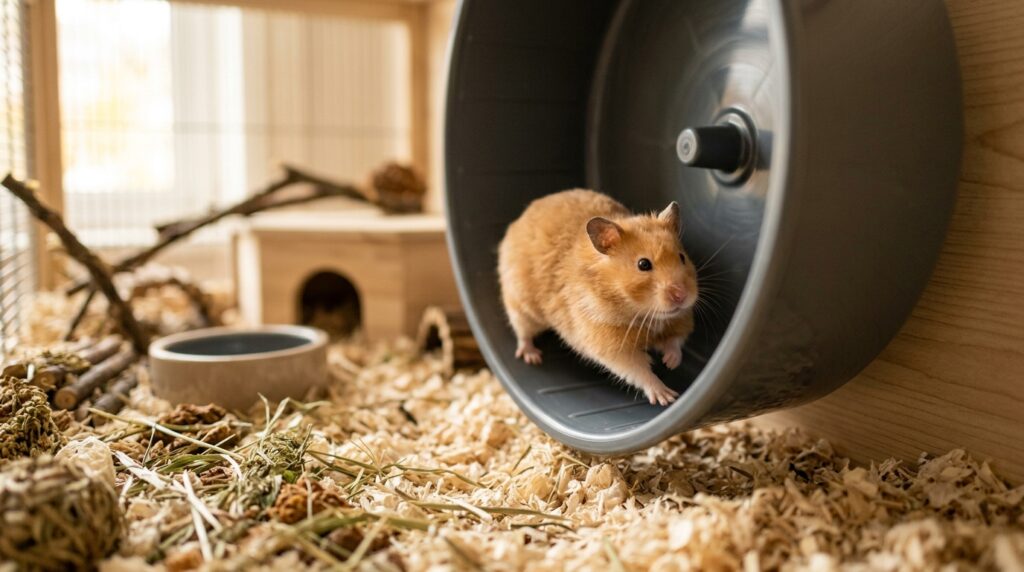
Choosing the right hamster wheel size is one of the simplest changes you can make to protect your hamster’s health, yet it is still one of the most commonly overlooked bits of kit. Too small a wheel and your hamster’s spine is forced into an unnatural curve every time they run, which can lead to real long term problems. 🐹💛
Why Hamster Wheel Size Matters So Much
Hamsters are naturally very active and can run several miles in a single night in the wild. A wheel is often their main source of exercise indoors, so getting the hamster wheel size right is essential for both physical health and mental wellbeing. If a wheel is too small, a hamster’s back is forced to arch upward as they run, putting ongoing strain on the spine.
Over time, running on an undersized wheel can contribute to spinal curvature and joint discomfort. This is especially true for larger breeds such as Syrian hamsters, but even smaller dwarf breeds need a wheel that lets their body stay in a natural, flat running position from nose to tail.
Correct Hamster Wheel Size by Breed
As a general welfare guide, here is what to look for when choosing hamster wheel size:
- Syrian hamsters: a minimum diameter of around 10 to 12 inches (roughly 25 to 30cm), since Syrians are the largest common pet hamster breed
- Dwarf hamsters (Campbell’s, Winter White, Roborovski): a minimum of around 8 inches (roughly 20cm), though bigger is always better where cage space allows
- General rule: your hamster’s back should stay flat and straight while running, with no visible arch upward at any point
If you are ever unsure, bigger is almost always the safer choice for hamster wheel size, as long as it fits comfortably in the cage alongside other essentials like hides, tunnels, and a deep digging area.
What to Avoid
- Wire mesh or rung-style wheels, which can trap tiny feet and cause injury
- Wheels that wobble, squeak loudly, or feel unstable, which can put your hamster off using them altogether
- Any wheel where your hamster’s back visibly curves upward while running, regardless of the size printed on the packaging
- Sharing one wheel between hamsters housed together, since hamsters (other than Roborovskis in some cases) should generally be housed alone as adults anyway
Solid Surface vs Wire Wheels
Alongside getting the hamster wheel size right, the running surface matters just as much. A solid, enclosed running surface is much safer than an open wire design, since wire wheels can catch tiny toes and tails, leading to painful injuries. A solid surface also tends to be quieter, which is kinder for both your hamster’s sensitive hearing and your own sleep if the cage is in a bedroom.
Signs Your Current Wheel Might Be the Wrong Size
- Your hamster’s back visibly arches or curves while running
- Your hamster avoids the wheel altogether despite otherwise being active at night
- You notice stiffness, an odd gait, or reluctance to move much during the day
- Your hamster seems to “hop” or shuffle rather than run smoothly on the wheel
If any of these apply, it is worth upgrading the hamster wheel size straight away and, if you have any concerns about existing discomfort or posture, booking a check with an exotics-experienced vet.
Common Myths About Hamster Wheel Size
A common myth is that the wheel sold as part of a starter cage kit is automatically the right size. Many mass-produced starter cages come with wheels that are far too small, particularly for Syrian hamsters, so it is always worth double-checking the diameter against breed guidance rather than assuming it is suitable.
Another myth is that smaller hamsters never need a bigger wheel. Even dwarf hamsters benefit from as much room as reasonably possible, since a flat running posture protects their spine regardless of their overall size.
Quick Recap
- Hamster wheel size directly affects spinal health, not just comfort
- Syrian hamsters need a minimum of 10 to 12 inches, dwarf breeds at least 8 inches
- Your hamster’s back should stay flat while running, never arched
- Solid, enclosed running surfaces are safer than wire mesh designs
- Starter cage wheels are often too small and worth checking straight away
Getting hamster wheel size right is a small change that makes a big difference to your hamster’s daily comfort and long term health. If you are thinking about welcoming a rescue hamster into your home, Greatfield Small Animal Rescue is always happy to help with advice on setting up the perfect, hamster-safe home. 🐹
Further Reading
FAQs
How do I know if my hamster’s wheel is too small?
Watch your hamster run. If their back curves upward at any point rather than staying flat, the wheel is too small for their breed and size.
Can a wheel be too big?
Not really from a health perspective, as long as it fits safely in the cage alongside other essentials. Bigger is generally safer than smaller.
Do dwarf hamsters need as big a wheel as Syrians?
Slightly less, but they still need a wheel large enough to keep their back flat while running, so checking the diameter is always worthwhile.